Some like it hot
Every summer, 20-something musicians head off to courses around the world to hone their skills and have a lot of fun. Why aren’t these opportunities available to us oldies?
There’s not much I envy young people today, especially those who have chosen music as their life’s work. It’s a tough existence, demanding resilience and drive, and more self-criticism and consistency than most civilians can muster. There’s just one thing, and I always feel the pinprick at this time of year: the summer course. One of my first jobs at The Strad was to compile its annual SummerPlus listings, and my mind would wander covetously as I picked up faxes that came from around the world, updating the details of teachers and classes, imagining myself in each.
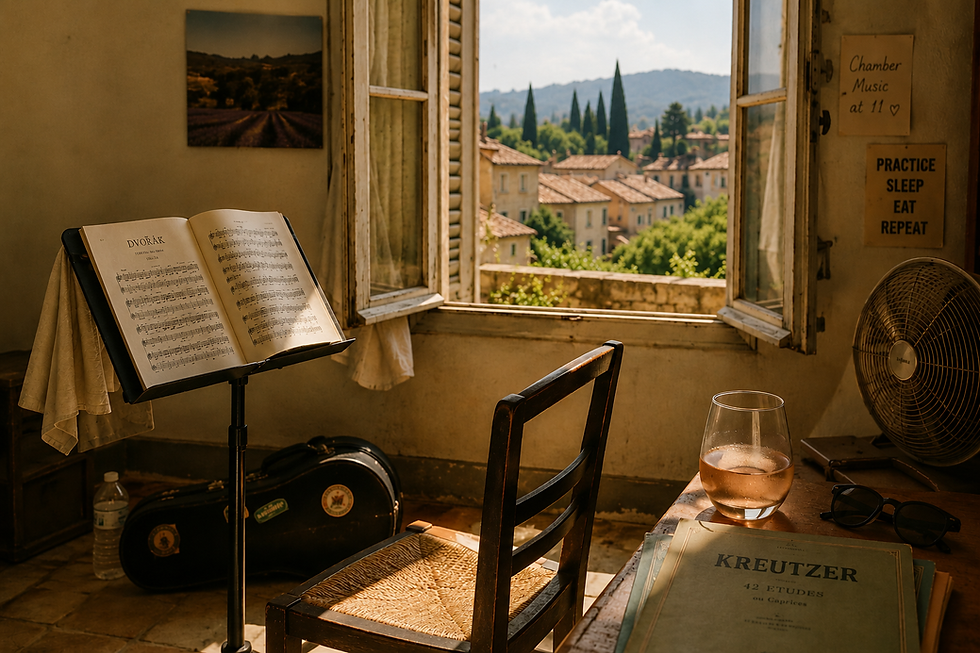
One of the perks of being a music student is spending the summer months in beautiful locations, working hard, learning from elders and peers, honing musical and technical skills. Alongside that, especially for those who have barely left school and family territory, it’s a chance to stretch out, meet new people, learn how to interact with them, and test the boundaries of who one is and wants to be. It’s a heady mix of hours alone in a practice room, classes that challenge intellectually and party-time evenings that release the tension.
This was all brought to my mind talking to violinist Midori for my BBC Music Magazine piece about the Ravinia Festival in Chicago, following up my visit there. This was her third year as Artistic Director of the piano and strings programme of Steans Institute, which runs alongside the festival. Her curriculum offers lessons, masterclasses and chamber music to international fellows, with an all-star faculty (including Jean-Efflam Bavouzet and Robert Levin as pianists; Augustin Hadelich and Carolin Widmann for strings), as well as practical and thought-provoking seminars.
Midori described the benefits of summer courses: ‘One of the advantages of summer programmes is that you get different perspectives, which you might decide to explore further later on. During the year, you go to school with the same group of friends. Here, you find players you haven’t met before, and you learn to meet them musically. That is very important. You get a taste for different ideas. Sometimes they are opposing and there’s no way you can incorporate all of them, but making that decision about how you’re going to play is a very important part of the interpretive process.’
When it comes to chamber music in general, it’s also a chance to learn to communicate well: ‘In collaborating with others, one has ideas, but one also has to be able to articulate and present them. We learn so much through this. You have to have a very clear idea of what you’re trying to do and present it in an effective way, and set up a collaborative working environment.’
She described the Steans atmosphere: ‘The environment is so open. Everyone is very eager, motivated, curious, supportive. It’s important to have this kind of dynamic in order to have the best learning opportunities. Our faculty and fellows come from different backgrounds, and we can exchange ideas, engage in making music together and learn from each other. It’s really motivating and inspiring.’
Our conversation brought back vivid memories for me of the summer courses I was lucky to attend in my 20s. I can’t recall how I made it on to Yossi Zivoni’s course in Entrecasteaux in Provence the summer before I graduated from Edinburgh University (not studying music). I do remember my mind short-circuiting when hearing the standard of playing, Zivoni’s quietly meticulous approach in classes and playing chamber music at a level I’d not previously experienced. I will forever associate Dvořák’s Piano Quintet with that wide-eyed summer – not to mention communal dinners in the square, pseudo-deep conversations over river walks, rosé wine on tap for the first time, outdoor Alexander Technique that left me floating, packing for the return coach still drunk from the last-night party, and desperately trying to learn to be cool. I’m not sure which of these was the catalyst to apply for music college, but I’m sure that wouldn’t have happened without that summer.
Following two years postgraduate at Royal Academy of Music, I wangled another invite – to YellowBarn in Vermont. I remember thrilling nightly chamber music in the tiny wooden space, legs dangling from the balcony, discovering iced coffee and toasted bagels, and listening to Mozart operas in the hifi room. There are other, more complex memories, though: lessons with Manny Hurwitz in which he described my playing as having ‘a sthlow metabolism’ and the cellist in my Dohnányi piano quintet storming off, calling me ‘brutal’. I’ve spent my life trying to combat these two devastatingly accurate diagnoses. Summer courses aren’t all about learning to play fast and drink slowly – some of the lessons are the most profoundly personal.
More recently, as an amateur, I reported on Burton Kaplan’s remarkable Magic Mountain Music Farm Practice Retreat, which was enlightening in offering new tools and efficient practice techniques (if only I have the discipline to use them). Burton also encouraged me to disprove Manny’s diagnosis by helping me to get a Wieniawski etude up to metronome mark with ease. The experience reminded me that in middle age, our brains are still malleable, even if our self-image is less so – I quickly reverted to Manny’s interpretation. I wrote about that here. I also went on Verbier Festival’s sadly short-lived Amateur Chamber Music course.
But it’s the solo aspect of summer courses that I really crave – the chance to hole up in a practice room for hours, valiantly battling one’s own dexterity, intellect, emotions and confidence (and social media addiction), with the comforting cacophonic companionship of fellow travellers coming from next door. Then there are the daily masterclasses – as an amateur orchestral player one rarely experiences the sheer fear of putting oneself in front of a teacher and one’s peers. The pay-off is watching other people going through the same process and maybe learning even more by watching them. All of that, plus beautiful sun-kissed countryside in a historic location, with communal meals and informal chamber music.
Summer courses teach you about your own limitations and possibilities, in a safe enough space to help you figure out the answers – all in beautiful surroundings with inspiring people and all mod cons provided so you can practise for hours a day, and play chamber music and hang out in the evening. That is all essential for innocent 20-somethings straight out of school, trying to find themselves in the big wide musical world. But why not for people of a certain age who want to challenge themselves, immerse themselves in music and defy not just their bodies but their own self-conception? Why do we not give adults these opportunities to continue questing throughout their lives, whether amateur or professional. (Burton’s course is the only one I know that also caters to ‘grown-up’ professionals.)
I often go on about the lack of high-level provision for amateurs – I’m considering a PhD on the connection (or disconnection) between the music business and amateurs – but I’m pretty certain there are others like me, and, as far as I’m aware, no provision among the many summer courses around the world. So, do I miss my youth? Absolutely not. Do I envy 20-something musicians this summer? Totally.