Seven ways to see a violinist
GALLERY What do artists see when they look at a violinist? These portraits offer very different ways to represent musicians – and their instrument
The fun thing about having a niche interest such as violins and violinists is that it often sends me down even nichier rabbit holes. Typing ‘violin’ into any search box acts like a compass for new adventures. In a recent quest for paintings of violinists, for example, I ended up in the Smithsonian archives, which hold the papers of violinist Louis Kaufman, and then wandered further into other collections.
So, I thought I’d do an occasional ‘Gallery’ series based on string-related works. I have no specialist art knowledge, so you won’t find insightful commentary, but I’ve tried to include some background and links to further information. I’ve selected relatively modern images that I find interesting or intriguing, and that defy the usual violin clichés.
1. Louis Kaufman (1905–1994), painted in 1932 by Lawrence Lebduska (1894–1966) at The Smithsonian

This painting doesn’t even have a violin in it, but I love the directness of the 26-year-old Louis Kaufman’s gaze, his dapper suit and the detail of the paintings in the background – Kaufman and his wife Annette were keen art collectors. In this 1985 oral history interview for the Smithsonian, he describes his friendship with Mark Rothko, which began at school, and how he fell in love with art in the 1920s, buying his first painting, by Mary Kumpt, for $25. He and Annette lived in a house designed by Lloyd Wright (son of Frank), alongside nearly 200 paintings, which Kaufman himself described as a ‘grab bag’.
Kaufman defends the couple’s taste, though: ‘We got to have a feeling of the universality of the art. I feel sorry for those people with little, snobbish tastes who still admire only the latest thing that they’re looking at or a Rembrandt or a Picasso or a Van Eyck at the expense of everything else. We all bow down to Rembrandt and the whole development of everything. But I think that everything that is conceived by human hands and brains and feeling is worthy of some attention if it’s sincere. If it’s not a copy, and if it’s done in a sincere way, it’s worthy of looking at very carefully.’
Perhaps there’s a correlation between this attitude to art and his violin playing. Kaufman may be one of the most-listened-to-yet-unknown violinists ever. His lush, brilliant, rubato-rich solos practically define Hollywood soundtracks of the golden age, including Top Hat, Gone with the Wind, Casablanca and Modern Times (his full contribution listed on IMDB), with composers including Korngold, Herrmann, Rózsa, Newman and Steiner.
At the same time, he performed the classical canon, and his 1947 recording of Vivaldi’s Four Seasons brought the piece back into the repertoire. Its opulent (verging on decadent) sustained sound, complete with organ, is a far cry from how Vivaldi is performed today, but I’d happily start a campaign to bring this playing back into style. He also championed composers of the time and gave world premieres including by Martinů and Milhaud, among others who are less well known today. Of 20th-century classics, his 1951 recording of the Barber Violin Concerto is incandescent (here in a slightly distorted YouTube), and – as he demanded of the paintings he bought, and as seems to transmit through this portrait – utterly sincere.
(Sidetrack: I was surprised to find portraits of violinists by Mark Rothko that are quite unlike his more famous style. They’re not in the public domain but you can find them here and here.)
2. Violinist: Study from life, second half of the 19th century by George du Maurier (1834–1896) at The Met

I’ve walked past George du Maurier’s house in Hampstead many times, and I knew he was the grandfather of one of my favourite novelists, Daphne du Maurier, but I hadn’t realised he was a fine cartoonist who drew for Punch, as well as a novelist. This really captures a player in thought and on the edge of movement, maybe to start playing again – or to give up and go home.
3. Johannes Wolff (1863–1931), painted in 1897 by John Singer Sargent (1856–1925) at Harvard Art Museum

John Singer Sargent was himself a talented amateur pianist and made portraits of many musicians, among them Fauré, Smythe, Heifetz, Casals and Joachim. Dutch-born, Paris-trained Johannes Wolff had a fairly international career as a soloist, inspiring an Andante by Fauré and the Caprice andalou by Saint-Saëns. At the time of this painting he was teaching at Guildhall School of Music in London, and the same year was invited to Balmoral to play for Queen Victoria, who signed a copy of the book Journal of a Life in the Highlands as a gift on his visit. Sargent signs the painting ‘A mon ami Johannes Wolff.’
I love the shadows and the sheer fleshiness of Sargent’s flesh, but most of all I love the rich reddy-browns of the varnish of Wolff’s violin, which may have been a Guarneri, according to a newspaper report of his 1886 South American tour.
4. Nathan Milstein (1904–1992), painted in 1943 by Jane White (1913–2011) at the Smithsonian

I’m not sure this captures Milstein’s features entirely accurately, but there is certainly something of his insouciance and lovely bowhold. Like the Sargent above, the violin is the real star of the show, its beautiful varnish bursting out of the canvas (Milstein was playing the 1710 ‘Dancla’ Stradivari in 1943, when this was painted).
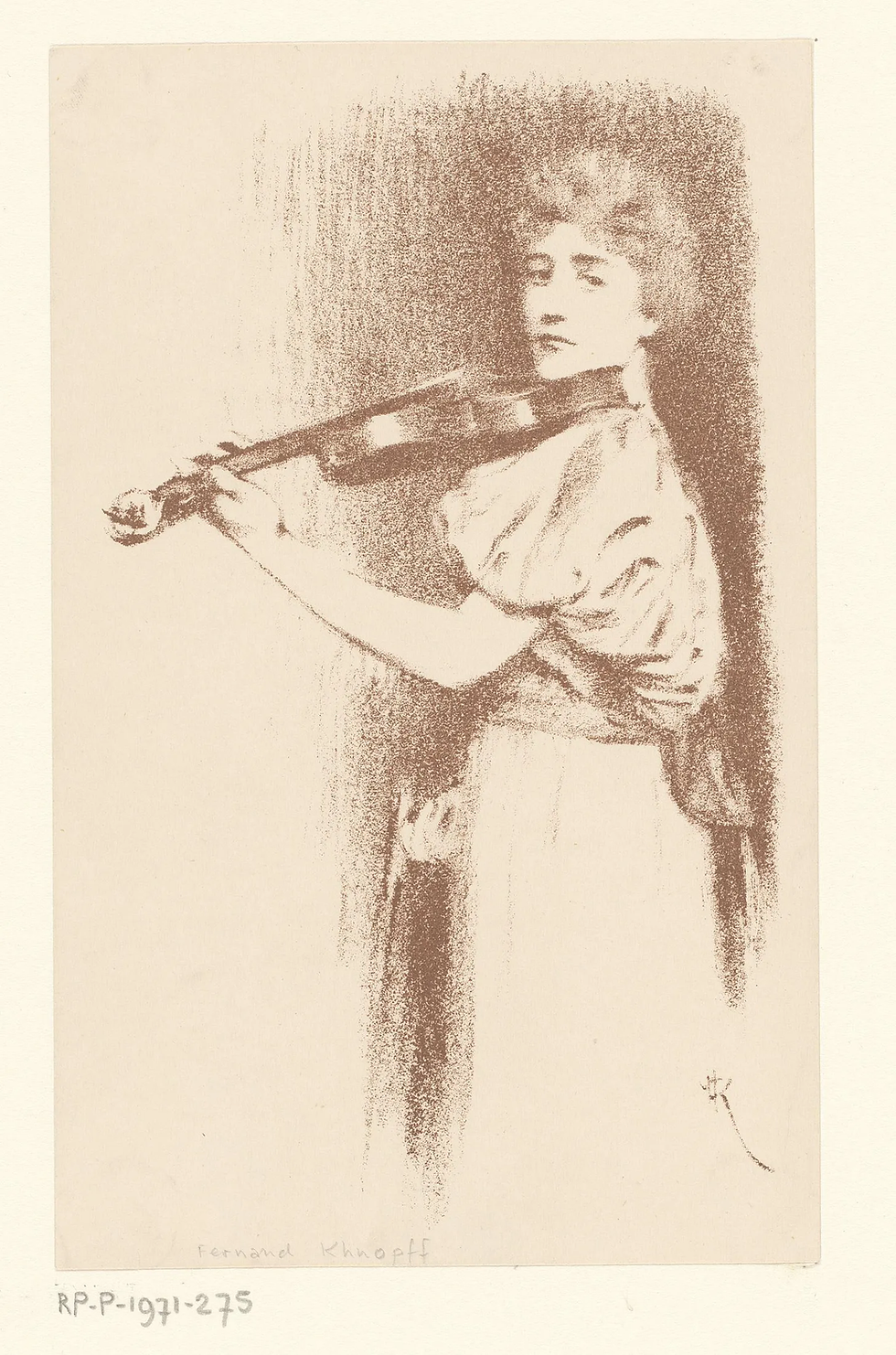
5. Violinist Fernand Khnopff (1868–1921) at Rijksmuseum
There’s no name or date listed for the violinist in this lithograph but it’s beautifully done, with minimal marks, and she’s not so much responding to the ‘male gaze’ as wordlessly implying, ‘You’re interrupting my practice’.
6. The Violin Concert (1903) Edvard Munch (1863–1944) Art Institute of Chicago
The violinist seems lost in thought as she listens to the pianist, waiting to come in. Munch’s violin itself is a little heavy-handed, but I don’t mind having the attention drawn to it, and how it seems to resonate with the violinist’s abundant hair.

7. Mystery painting
This one is a total enigma. My brother Rafael bought it at auction and has so far been unable to identify the violinist or painter, but the distracted expression and relaxed hands are rather wonderful. Get in touch if you have any ideas!

If you have any more information to add about these pictures, please share them!
Next time… seven cellists!